Classroom Game
Tong Lego Challenge: An Introduction to Optimization
Thanks for your interest in the Tong Lego Challenge! I had a lot of fun creating this game for my classes. You're welcome to adapt and use it for your teaching or other noncommercial use. Beyond giving appropriate credit, my only request is that if you do download my materials and play the game with a group, you tell me who you are and send me a photo of your group playing it! 📷 😀
What is the Tong Lego Challenge (TLC)?
The TLC is a simple constrained integer program turned into a game that you can play in a classroom with Legos. In each round of the game, your team acts as a boutique woodworking company who must decide which items to build and sell to the market. The goal is to decide how many of each type of item to build to maximize profits and beat other teams, where you are constrained by how many component pieces you have available. The learning objectives are to:
- Help students conceptualize optimization model components and definitions.
- Motivate the value of learning how to build optimization models.
Why did I make this game?
I created the Tong Lego Challenge (TLC) after a few years of teaching my “Prescriptive Modeling and Optimization” course to (primarily) masters of business analytics students. A few trends and observations motivated me to do so:
- GenAI. The development of GenAI reduces the importance of knowing the details of how to code and debug. At the same time, it increases the importance of being able to more deeply understand and communicate at a more conceptual level the optimization model you want programmed or analysis you want performed.
- Memorable foundation. I wanted something memorable to be able to refer to as common knowledge whenever students had trouble remembering or conceptualizing definitions (e.g., objective, decision variables, and constraints) or other optimization-related concepts.
- Engagement. I needed something more light-hearted and engaging following an exam to introduce the optimization module. I also wanted more yelling in my class; a surefire way to get engagement, in my opinion 😁.
How do you play this game?
A more complete teaching note and materials are provided in the downloads. In general, the game has 3 rounds that go like this:
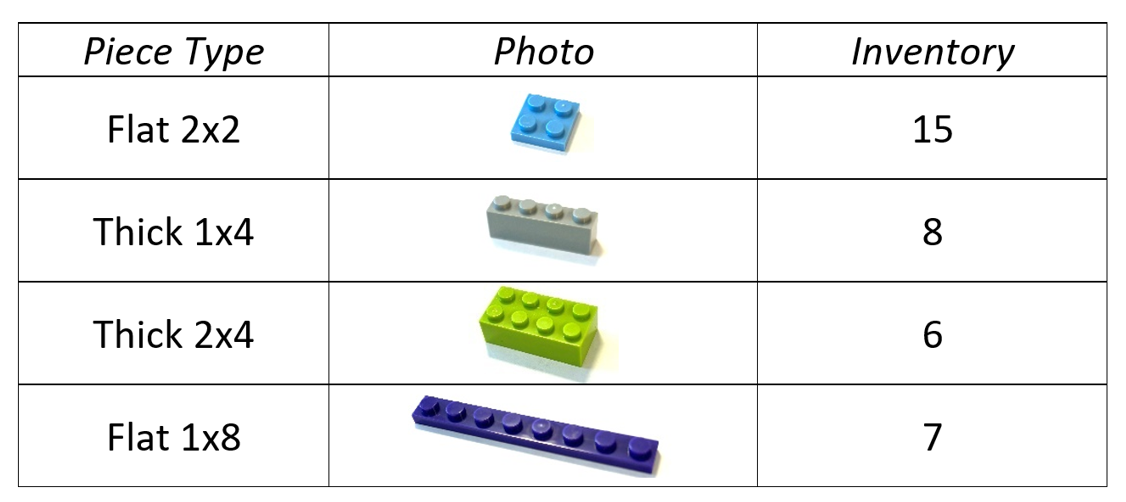
Round 1 is the “base game.” Each team has a Lego kit of these pieces:
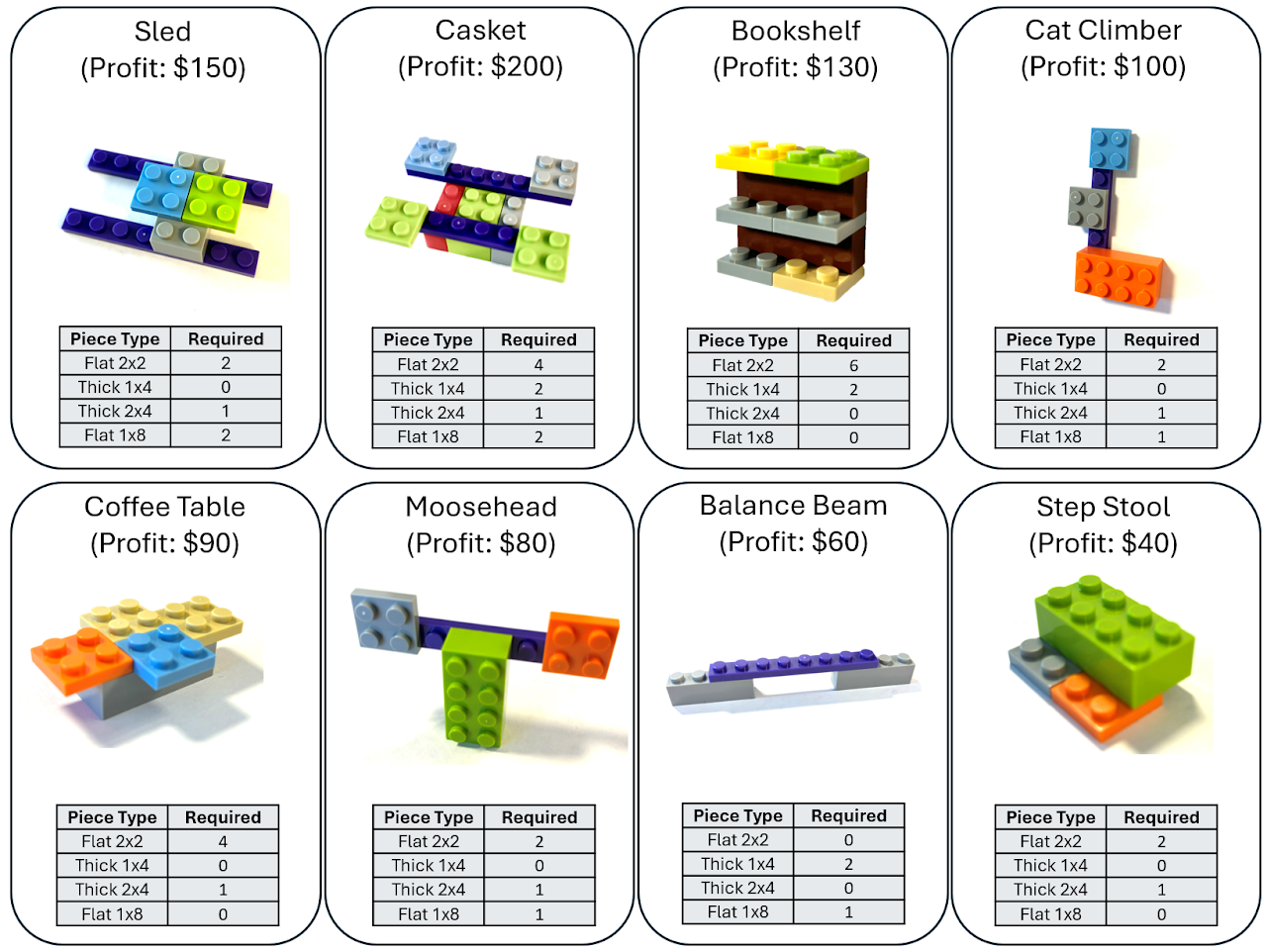
Their job is to try to assemble the pieces to these items in a way that makes the most profit:
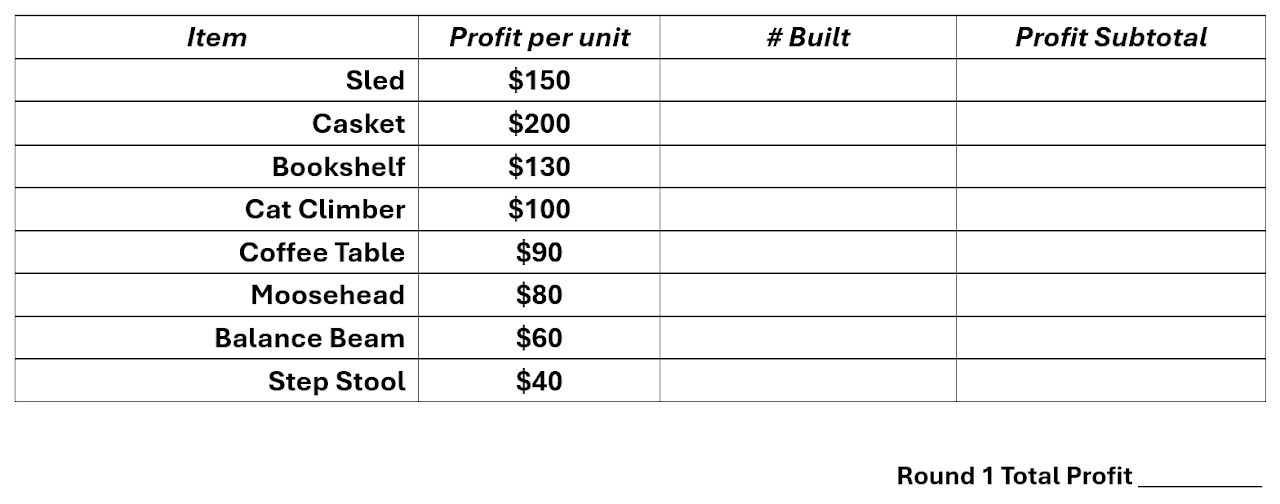
They then tally up their scores in a sheet like this:
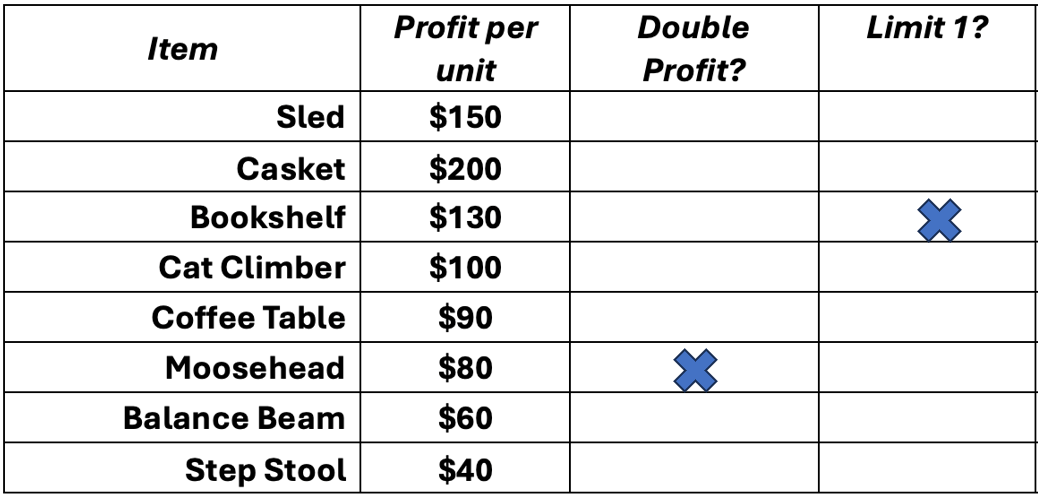
Before Round 2, the moderator determines which items were built the most and which item was built the least. The one that was built the most is worth double. The one that is worth the least you can only build at most 1 of them. So, teams would just adjust their Round 2 score sheets to something like this:
They build again and tally up Round 2 scores.
Before Round 3, the moderator introduces and auctions off 3 “packs” of additional Lego pieces to the highest bidding team (yelling here is encouraged 📢😱😄 — try to channel your inner auctioneer voice; see an example from Storage Wars). Here are the 3 packs:
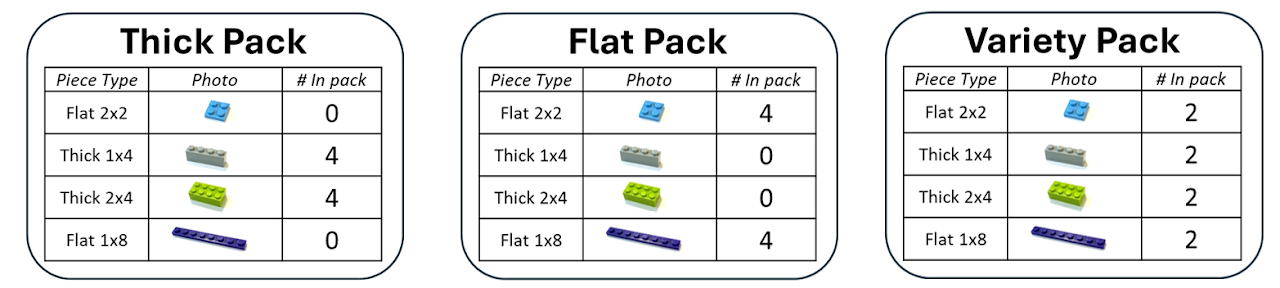
Each pack auction winner must first pay their bid by deducting that many dollars at their start of Round 3. Then, the moderator also updates which items double in profit and which items have limit 1, e.g.,
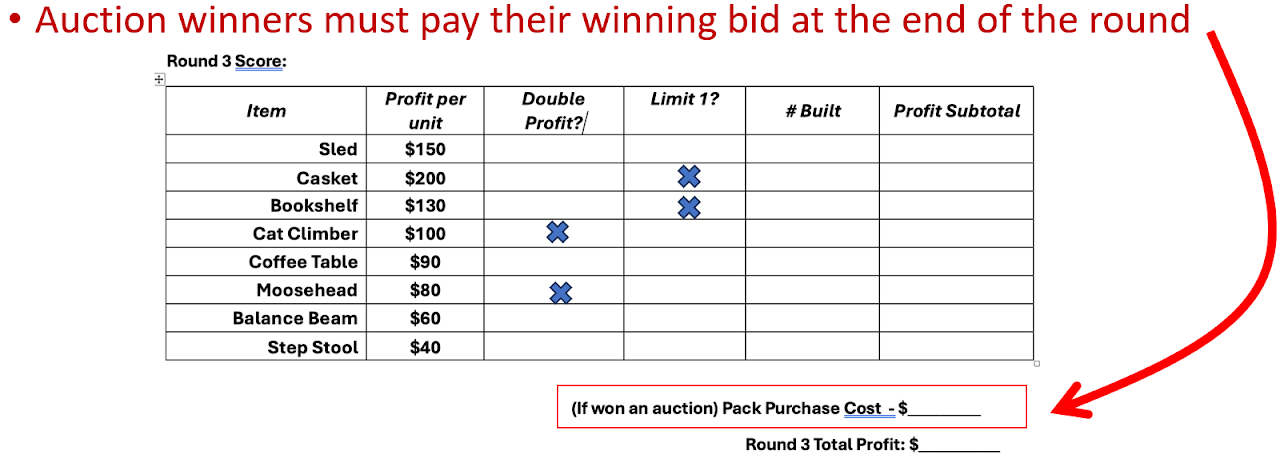
Finally, at the end of Round 3, everyone tallies up their team's total profits over all 3 rounds. Highest profiting team wins!
Debriefing and discussion
In my class, the TLC falls after we work through the basics of building and analyzing models in Excel or Python. Before this class there is also a video lecture introducing optimization at a more abstract level. Therefore, I use the TLC as an opportunity to review those ideas and ask students questions to see if they can identify the components in the TLC. What is the objective? What are the decision variables? What are the constraints?
I then also walk students through how an Excel model could be used for decision support even without optimization. Finally, I illustrate how to convert such a model into an optimization model, showing how it would look to use Excel's Solver to find Round 1's highest profit possible:
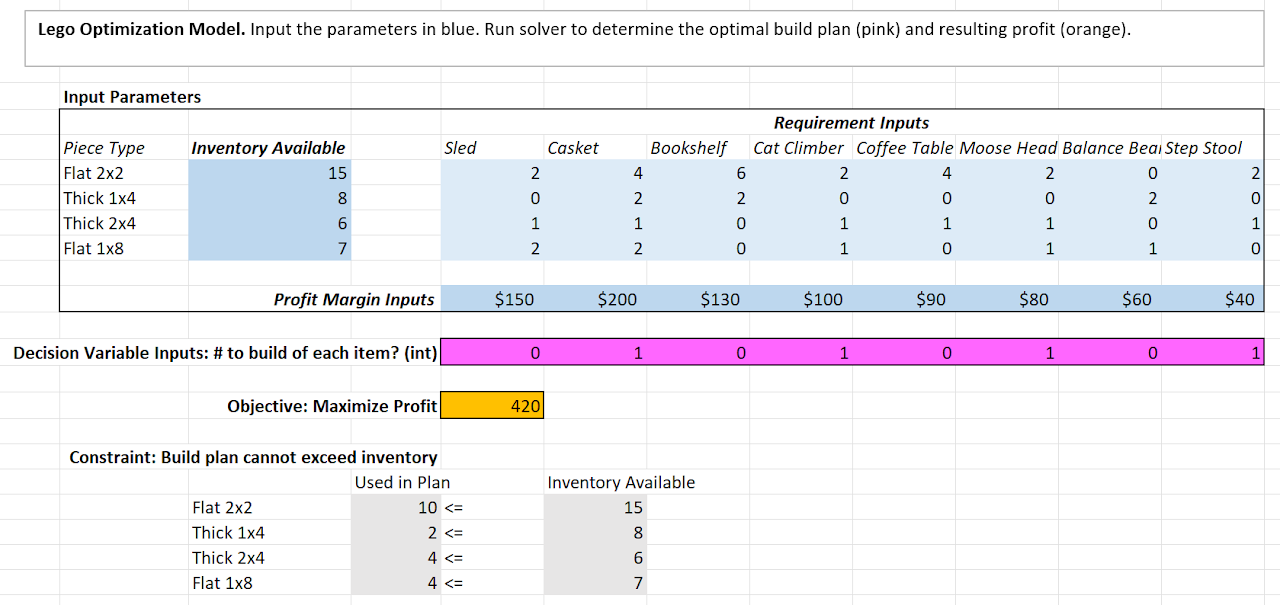
Finally, I have students discuss some questions with their neighbors or write it up in their homeworks: How would they adapt the model to help with decision support for Rounds 2 and 3?
There are also other opportunities for discussion. For example, the auction in Round 3 is a good opportunity to discuss the winner's curse.
Licensing & usage guidelines
You are free to use and adapt this teaching material for classroom and other non-commercial educational purposes. You do not need to call it “Tong Lego Challenge.”
As a personal request — if you decide to play this challenge in a group, I'd love to see it in action! Please send me a picture by email to jordan.tong@wisc.edu.
License. Tong Lego Challenge © 2025 by Jordan Tong is licensed under a Creative Commons Attribution-NonCommercial 4.0 International License.
✅ You may share and modify this material for non-commercial educational purposes.
✅ You must provide appropriate credit to the author (Jordan Tong) when using or adapting the game.
❌ You may not sell, redistribute for profit, or use this material for commercial purposes without express permission.
Attribution. If you use or adapt the Tong Lego Challenge, please include: “Adapted from the Tong Lego Challenge by Jordan Tong. Used under CC BY-NC 4.0.”
Disclaimer. This game is provided “as is” for educational use only. The author makes no warranties regarding its applicability to real-world decision-making.